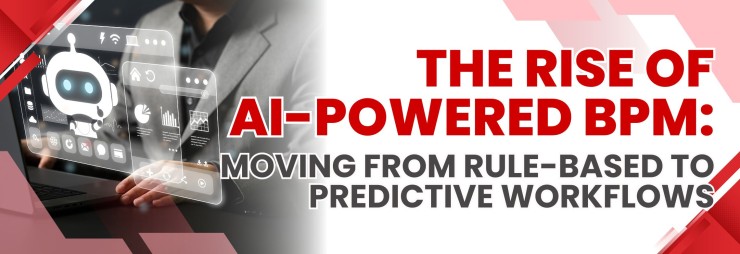

Image Source - Openxcell
Executive Overview
Business Process Management (BPM) is entering a new era driven by Artificial Intelligence (AI). While traditional rule-based workflows have long helped organizations standardize repetitive tasks and enforce operational consistency, they often fall short in today's fast-changing digital landscape. Modern businesses particularly SaaS companies and technology startups must respond quickly to shifting customer expectations, fluctuating market conditions, and increasingly complex operational demands. Static workflows built on predefined rules are no longer sufficient to support this level of agility.
AI-powered Business Process Management (AI-powered BPM) is transforming process automation by introducing predictive intelligence into everyday business operations. Rather than simply executing predefined instructions, AI-enabled workflows analyze historical and real-time data, recognize patterns, predict future outcomes, and recommend or automate the next best action. This shift moves organizations from reactive process management to proactive, data-driven decision-making, enabling workflows that continuously learn, adapt, and improve over time.
For SaaS founders and tech startups, this evolution offers far more than incremental efficiency gains. AI-driven process automation helps reduce manual intervention, accelerate customer onboarding, improve resource allocation, strengthen compliance, and enhance customer experiences through intelligent, context-aware automation. By combining technologies such as machine learning, predictive analytics, natural language processing (NLP), and intelligent decision engines, organizations can streamline complex workflows while uncovering valuable operational insights that drive strategic growth.
As digital transformation accelerates across industries, adopting predictive workflows is becoming a key differentiator for businesses seeking to scale efficiently without proportionally increasing operational costs. Organizations that embrace intelligent automation today are better positioned to improve productivity, respond to market changes faster, and build resilient business processes capable of supporting long-term innovation.
In this article, we explore how AI-powered BPM is redefining Business Process Management, examine the technologies behind predictive workflows, discuss practical implementation strategies and industry use cases, compare traditional and AI-driven BPM approaches, and highlight why intelligent automation is becoming an essential investment for modern SaaS businesses and technology startups.
Why AI-Powered BPM Is Reshaping Modern Business Operations
Today's SaaS companies and tech startups operate in a fast-paced environment where agility, scalability, and customer experience drive success. Traditional Business Process Management (BPM) systems have streamlined operations through predefined rules, such as:
If payment is received, activate the subscription.
If an invoice exceeds the approval limit, notify the manager.
If a support ticket is submitted, assign it to Level 1 support.
While these rule-based workflows improve efficiency and consistency, they are reactive and require manual updates as business needs evolve. They cannot predict delays, identify process bottlenecks, or adapt to changing customer behaviors without human intervention.
AI-powered BPM transforms this approach by combining Machine Learning (ML), Predictive Analytics, Natural Language Processing (NLP), and Intelligent Automation to create workflows that learn from data, anticipate outcomes, and optimize decisions in real time. Instead of simply following predefined rules, predictive workflows analyze historical patterns and operational data to recommend or execute the most effective next action.
For SaaS founders and tech startups, adopting AI-driven process automation means improving operational efficiency, reducing manual effort, enhancing customer experiences, and building scalable workflows that adapt as the business grows. This shift from rule-based automation to predictive workflows is redefining the future of intelligent business operations.
Main Topic Overview Understanding Traditional Rule-Based BPM
Business Process Management (BPM) has long been the foundation of operational efficiency, helping organizations standardize repetitive tasks, reduce manual effort, and maintain consistency across departments. Traditional BPM systems operate using predefined business rules often referred to as "if-then" logic that dictate how a process should proceed under specific conditions. These workflows are designed in advance and execute the same sequence of actions every time the defined criteria are met.
For example, a traditional BPM system may:
Route invoices to the finance department based on the invoice amount or department.
Trigger a manager's approval automatically after an employee submits an expense report.
Send welcome emails and onboarding documents immediately after a customer registers for a SaaS platform.
Escalate unresolved customer support tickets to senior agents after 24 hours.
Generate purchase orders when inventory levels fall below a predefined threshold.
Notify HR when an employee completes mandatory training or probation.
Assigning new sales leads to representatives based on geographic location or predefined territories.
These rule-based workflows are highly effective for organizations with structured, repetitive, and predictable business operations. They eliminate repetitive manual tasks, reduce human error, improve compliance, and ensure that business processes follow standardized procedures. For many years, they have served as the backbone of digital transformation initiatives across industries.
However, today's SaaS companies and technology startups operate in a business environment that is far more dynamic than the one these systems were originally designed for.
Why Traditional BPM Falls Short in Modern Businesses
Unlike large enterprises with relatively stable operations, startups constantly adapt to changing customer expectations, rapid product development cycles, and evolving market conditions. Their workflows often need to change quickly, making rigid rule-based automation increasingly difficult to maintain.
Modern SaaS businesses experience challenges such as:
Customer demand fluctuates due to seasonal trends, marketing campaigns, or product launches.
Teams grow rapidly, requiring new approval structures and internal processes.
Market conditions change because of competition, regulatory updates, or emerging technologies.
Product features evolve continuously, introducing new workflows and customer journeys.
Customer support volume increases unexpectedly during releases or service disruptions.
Sales processes become more complex as businesses expand into new markets.
Remote and hybrid work environments require flexible collaboration across distributed teams.
In these situations, traditional BPM systems require administrators to manually update workflow rules whenever business conditions change. This process is time-consuming, increases maintenance costs, and often causes delays in responding to new business needs.
Key Limitations of Rule-Based BPM
Although rule-based automation remains valuable for handling straightforward tasks, it has several limitations in fast-growing organizations:
1. Manual Workflow Updates
Every process change requires IT teams or process administrators to modify workflow rules manually. As businesses grow, maintaining hundreds of interconnected rules becomes increasingly complex.
2. Limited Decision Intelligence
Traditional BPM executes predefined instructions but cannot evaluate context or make intelligent decisions. It lacks the ability to analyze customer behavior, operational data, or historical trends before determining the next action.
3. Reactive Rather Than Proactive
Most rule-based systems respond only after an event occurs. For example, they escalate a delayed support ticket after the SLA is breached rather than predicting which tickets are likely to miss their deadlines.
4. No Predictive Capabilities
These systems cannot forecast customer churn, identify potential process bottlenecks, estimate future workloads, or recommend preventive actions based on historical data.
5. Hidden Process Inefficiencies
Traditional BPM focuses on executing workflows rather than analyzing them. As a result, recurring bottlenecks, unnecessary approvals, duplicate tasks, and inefficient resource allocation often remain unnoticed.
6. Difficulty Handling Exceptions
Rule-based systems perform well when processes follow expected paths. However, they struggle with unexpected scenarios such as incomplete customer information, unusual transactions, changing regulations, or exceptions that fall outside predefined rules.
7. Limited Scalability
As startups scale, workflows become more interconnected across departments like sales, marketing, finance, HR, customer success, and product development. Managing an ever-growing set of business rules becomes increasingly difficult, slowing innovation and reducing operational agility.
The Shift Toward Intelligent Automation
These challenges have paved the way for AI-powered Business Process Management (AI-powered BPM). Instead of relying solely on static business rules, intelligent automation combines Artificial Intelligence, Machine Learning, predictive analytics, and real-time data processing to create workflows that can learn, adapt, and improve over time.
Rather than asking, "Which predefined rule should execute?", AI-powered BPM asks, "What is the best next action based on current data and historical patterns?"
For example, an AI-enabled workflow can:
Predict which customer support tickets require immediate attention before SLAs are missed.
Automatically prioritize high-value sales leads based on their likelihood to convert.
Recommend the fastest approval path for purchase requests by analyzing previous approval behavior.
Detect unusual financial transactions and flag them for review before they become compliance issues.
Forecast staffing requirements based on seasonal demand and historical workload trends.
This transition from rule-based automation to predictive, intelligent workflows allows SaaS founders and tech startups to build more agile, scalable, and data-driven operations. Instead of simply automating repetitive tasks, businesses can proactively optimize processes, improve customer experiences, reduce operational costs, and make faster, more informed decisions. As organizations continue to generate larger volumes of data, intelligent automation is becoming the next evolution of Business Process Management, transforming BPM from a system of execution into a system of continuous learning and optimization.
What Makes AI-Powered BPM Different?
Artificial Intelligence (AI)-powered Business Process Management (BPM) represents a major evolution from traditional workflow automation. While conventional BPM systems rely on predefined rules and static workflows, AI-powered BPM introduces intelligence that enables business processes to learn, adapt, and improve over time. Instead of simply executing a sequence of programmed actions, AI analyzes data, identifies patterns, predicts future outcomes, and recommends the best course of action all with minimal human intervention.
Traditional BPM asks a straightforward question:
"What rule should I execute ?"
For example:
If an invoice exceeds $5,000, send it to a manager for approval.
If a customer submits a support ticket, assign it to the first available agent.
If a payment is overdue, send a reminder email.
These workflows work well for repetitive, predictable tasks. However, they cannot adapt when business conditions change or when unexpected situations arise. Every exception requires manual updates to the workflow, making the system less flexible as the organization grows.
AI-powered BPM changes the approach by asking:
"What is most likely to happen next, and what action will produce the best outcome?"
Rather than relying solely on fixed rules, AI continuously analyzes historical records, real-time operational data, customer interactions, employee performance, and external business factors. Using machine learning and predictive analytics, it identifies trends that humans may overlook and makes intelligent recommendations based on probability rather than predefined instructions.
For example, instead of routing support tickets on a first-come, first-served basis, an AI-powered BPM system can analyze customer history, issue complexity, service-level agreements (SLAs), and agent expertise to automatically assign each request to the most suitable representative. This results in faster resolution times and higher customer satisfaction.
Similarly, in finance operations, AI can predict which invoices are likely to face approval delays and proactively notify stakeholders before deadlines are missed. In HR, AI can identify hiring bottlenecks and recommend process improvements based on historical recruitment data. In sales, predictive workflows can prioritize high-value leads by analyzing buying behavior, engagement levels, and previous interactions, allowing sales teams to focus on opportunities with the highest conversion potential.
AI analyzes millions of process events to:
Predict workflow delays: Identify tasks that are at risk of missing deadlines and recommend preventive actions before issues occur.
Recommend optimal routing: Automatically direct tasks, approvals, or customer requests to the most appropriate employee or department based on workload, expertise, and historical performance.
Detect anomalies: Identify unusual process behaviors, duplicate transactions, compliance risks, or potential fraud before they escalate into larger problems.
Forecast customer behavior: Predict customer churn, purchase intent, subscription renewals, or support needs by analyzing behavioral data and engagement patterns.
Prioritize high-value tasks: Rank activities based on urgency, business impact, revenue potential, or customer importance to ensure critical work is completed first.
Optimize resource allocation: Balance employee workloads, recommend staffing adjustments, and allocate resources more efficiently based on demand forecasts and operational capacity.
One of the most valuable aspects of AI-powered BPM is its ability to continuously learn and improve. Every completed workflow generates new data that the AI uses to refine its predictions and recommendations. As more information becomes available, the system becomes increasingly accurate at identifying bottlenecks, reducing errors, and optimizing business processes without requiring constant manual updates.
This continuous learning capability enables organizations to move beyond reactive process management. Instead of responding to problems after they occur, businesses can anticipate risks, optimize operations proactively, and make faster, data-driven decisions. For SaaS founders and tech startups, this means improved scalability, reduced operational costs, enhanced customer experiences, and the agility needed to compete in rapidly changing markets.
Ultimately, AI-powered BPM transforms workflow automation from a static, rule-based system into an intelligent decision-making platform. By combining automation with predictive intelligence, organizations can create adaptive workflows that not only execute tasks efficiently but also continuously evolve to support long-term business growth and innovation.
Core Technologies Behind Predictive Workflows
The shift from rule-based automation to predictive Business Process Management (BPM) is powered by several advanced Artificial Intelligence (AI) technologies. Unlike traditional automation, which simply follows predefined instructions, these technologies analyze data, recognize patterns, predict future outcomes, and continuously improve workflow performance.
For SaaS founders and tech startups, understanding these core technologies is essential to building intelligent, scalable, and future-ready business operations.
1. Machine Learning (ML)
Machine Learning is one of the foundational technologies behind AI-powered BPM. It enables systems to learn from historical data, identify hidden patterns, and improve decision-making without requiring manual updates to business rules.
Instead of following static instructions, machine learning models analyze thousands or even millions of process records to recognize trends and make increasingly accurate predictions over time. As more data becomes available, the models continuously refine themselves, making workflows smarter and more efficient.
For example, a SaaS company can use machine learning to identify customers who are likely to cancel their subscriptions based on product usage, login frequency, support interactions, and payment history. The system can then automatically trigger personalized retention campaigns before the customer decides to leave.
Common applications include:
Customer churn prediction
Sales and revenue forecasting
Lead scoring and prioritization
Intelligent ticket prioritization
Fraud detection
Process bottleneck identification
Demand forecasting
Resource allocation optimization
By continuously learning from operational data, machine learning helps organizations improve workflow accuracy, reduce manual intervention, and make proactive business decisions.
2. Natural Language Processing (NLP)
Businesses generate massive amounts of unstructured data every day through emails, chat conversations, customer feedback, contracts, invoices, and support tickets. Traditional BPM systems struggle to process this type of information because it doesn't follow a structured format.
Natural Language Processing (NLP) bridges this gap by enabling AI systems to understand, interpret, and analyze human language. NLP transforms unstructured text into actionable business insights that can be integrated into automated workflows.
For instance, when a customer submits a support request, NLP can automatically detect the issue type, identify the urgency, analyze customer sentiment, and route the ticket to the most appropriate support team without requiring manual review.
NLP is commonly used for:
Email classification
Support ticket categorization
Contract analysis
Document summarization
Chatbot conversations
Customer sentiment analysis
Knowledge management
Intelligent document search
For SaaS companies handling thousands of customer interactions each month, NLP significantly reduces response times while improving service quality and operational efficiency.
3. Predictive Analytics
Traditional reporting explains what has already happened. Predictive analytics goes a step further by estimating what is likely to happen next.
Using historical business data, statistical models, and machine learning algorithms, predictive analytics identifies future trends, risks, and opportunities before they affect operations. This allows organizations to shift from reactive management to proactive decision-making.
For example, instead of discovering that customer support response times have already exceeded service-level agreements (SLAs), predictive analytics can warn managers several hours or even days in advance, allowing teams to allocate additional resources before service quality declines.
Predictive analytics can forecast:
Missed SLA deadlines
Subscription cancellations
Customer lifetime value
Payment delays
Inventory shortages
Support ticket volumes
Employee workload fluctuations
Revenue trends
Project completion risks
These predictive insights help business leaders optimize workflows, improve planning, reduce operational risks, and deliver better customer experiences.
4. Intelligent Decision Engines
One of the biggest limitations of traditional BPM systems is that every decision depends on predefined rules. However, real-world business situations are often too complex for simple "if-then" logic.
Intelligent Decision Engines use AI algorithms to evaluate multiple variables simultaneously before determining the most appropriate course of action. Rather than following fixed rules, these systems assess real-time business conditions and make context-aware decisions.
For example, when assigning a customer support request, the AI may consider:
Customer Lifetime Value (CLV)
Subscription plan
Historical purchase behavior
Current support agent workload
Customer sentiment
Previous interaction history
Risk score
SLA commitments
Instead of simply assigning the ticket to the next available agent, the system intelligently routes it to the employee most likely to resolve the issue quickly while maximizing customer satisfaction.
Other use cases include:
Dynamic workflow routing
Loan approval recommendations
Insurance claim processing
Personalized product recommendations
Pricing optimization
Resource scheduling
Compliance monitoring
By evaluating multiple factors simultaneously, intelligent decision engines improve operational accuracy while reducing delays and manual intervention.
5. Robotic Process Automation (RPA) with AI
Traditional Robotic Process Automation (RPA) excels at automating repetitive, rule-based tasks such as copying data between systems, generating reports, or processing invoices. However, conventional bots struggle when exceptions occur or when information is incomplete.
By integrating Artificial Intelligence with RPA, businesses create Intelligent Process Automation (IPA), where software bots become capable of learning, adapting, and making decisions based on changing business conditions.
AI-enhanced RPA bots can:
Read and interpret invoices and forms
Extract information from scanned documents using Optical Character Recognition (OCR)
Learn from previous exceptions
Understand natural language requests
Handle changing data formats
Detect anomalies during process execution
Recommend workflow improvements
Make contextual decisions without human intervention
For example, an AI-powered finance bot can automatically receive supplier invoices via email, extract invoice details, validate the data against purchase orders, detect discrepancies, route exceptions to the finance team, and approve standard invoices without manual involvement.
This combination of AI and RPA creates highly resilient automation that reduces processing times, minimizes human errors, improves compliance, and enables organizations to scale operations efficiently.
Bringing These Technologies Together
While each of these technologies delivers significant value individually, their true power lies in working together within an AI-powered BPM platform. Machine Learning identifies patterns, NLP understands human language, Predictive Analytics forecasts future outcomes, Intelligent Decision Engines make context-aware decisions, and AI-enhanced RPA executes tasks with speed and precision.
Together, they transform traditional workflows into intelligent, self-optimizing processes that continuously learn, adapt, and improve. For SaaS founders and tech startups, this means faster operations, lower costs, enhanced customer experiences, and the agility to scale efficiently in a competitive digital landscape.
Solutions, Tools, and Strategies
Successfully implementing AI-powered Business Process Management (BPM) involves much more than investing in AI software. Organizations need a well-planned strategy that aligns technology with business objectives, process optimization, and continuous improvement. By identifying the right workflows, preparing quality data, selecting suitable AI tools, and monitoring performance, businesses can maximize the return on their automation investment. Below are the key strategies for building intelligent, predictive workflows.
1. Identify High-Impact Processes

Image Source - LeewayHertz
The first step in adopting AI-powered BPM is identifying business processes that will deliver the highest value when automated. Not every workflow requires AI, so organizations should prioritize processes that are repetitive, data-intensive, time-consuming, or prone to human error.
Focus on workflows that involve:
High transaction volume: Processes such as invoice processing, order management, claims handling, or customer support requests that occur hundreds or thousands of times daily.
Manual approvals: Multi-level approval workflows that often slow down operations due to human intervention.
Frequent delays or bottlenecks: Processes where tasks regularly exceed deadlines or create operational backlogs.
Customer interactions: Activities such as onboarding, support ticket routing, service requests, and personalized communication that directly impact customer satisfaction.
Compliance monitoring: Regulatory processes requiring continuous documentation, auditing, and policy enforcement.
By targeting these areas first, organizations can achieve measurable improvements in productivity, operational efficiency, and customer experience while generating a faster return on investment (ROI).
Why High-Impact Processes Matter
AI delivers the greatest value when applied to workflows with significant business impact. For example, a SaaS company receiving thousands of customer support tickets each month can use AI to automatically classify, prioritize, and route requests based on urgency, customer history, and sentiment analysis. Instead of relying on predefined rules, AI predicts which cases require immediate attention, reducing response times and improving service quality.
Similarly, finance teams can automate invoice approvals by allowing AI to detect anomalies, validate payment details, and recommend approval decisions based on historical transaction data. This significantly reduces manual workload while minimizing processing errors.
Evaluate Process Readiness
Before implementing AI, organizations should conduct a process assessment by asking questions such as:
Which workflows consume the most employee time?
Where do delays frequently occur?
Which processes generate the highest operational costs?
What repetitive tasks could be automated without compromising quality?
Where do employees spend time making routine decisions based on historical information?
Answering these questions helps prioritize automation projects with the highest business value.
Process Discovery Using Data
Modern AI-powered BPM platforms include process mining capabilities that analyze event logs from ERP, CRM, HRMS, and other business applications. These tools automatically visualize how work actually flows through an organization, revealing hidden bottlenecks, unnecessary steps, and compliance gaps that may not be visible through manual analysis.
Rather than relying on assumptions, process mining provides data-driven insights that help businesses identify the workflows most suitable for predictive automation.
Best Practices
To maximize success when identifying high-impact processes:
Start with one or two critical workflows instead of attempting organization-wide automation.
Select processes with clearly measurable KPIs, such as processing time, error rates, or customer satisfaction scores.
Involve employees who perform the daily tasks to identify pain points and improvement opportunities.
Document the current ("as-is") workflow before designing the AI-enhanced ("to-be") process.
Continuously review and refine automated workflows as business needs evolve.
Beginning with high-impact processes creates quick wins, builds confidence in AI adoption, and establishes a strong foundation for expanding intelligent automation across the organization. As predictive workflows mature, businesses can automate increasingly complex operations while improving decision-making, scalability, and overall operational excellence.
2. Collect High-Quality Process Data

Image Source - Go Wombat
The success of AI-powered Business Process Management (BPM) depends heavily on the quality of the data used to train predictive models. Unlike traditional rule-based systems that follow predefined instructions, AI learns from historical and real-time business data to identify patterns, predict outcomes, and recommend the best course of action. If the data is incomplete, outdated, inconsistent, or inaccurate, the AI model will produce unreliable predictions, reducing the effectiveness of intelligent automation.
To build a strong foundation for predictive workflows, organizations should gather and unify data from multiple business systems. This creates a comprehensive view of operations and enables AI to make more informed decisions.
Key data sources include:
Customer Relationship Management (CRM) Systems: Provide customer profiles, sales pipelines, interaction history, lead status, purchase behavior, and support requests. AI uses this information to predict customer churn, identify upsell opportunities, and prioritize high-value clients.
Enterprise Resource Planning (ERP) Platforms: Offer operational data related to inventory, procurement, finance, supply chain, and production. Integrating ERP data helps AI forecast demand, optimize resource allocation, and identify process bottlenecks.
Customer Support Software: Help desk platforms generate valuable insights into ticket volume, response times, issue categories, customer satisfaction scores, and recurring problems. AI analyzes these patterns to predict support workloads, automate ticket routing, and improve service quality.
Finance Applications: Financial systems provide information on invoices, payments, cash flow, expenses, and budgeting. Predictive models use this data to forecast revenue, detect payment delays, identify financial risks, and automate approval workflows.
User Behavior Analytics: Website analytics, product usage metrics, clickstream data, and application logs reveal how customers interact with digital products. AI can identify usage trends, predict feature adoption, recommend personalized experiences, and detect users who may be at risk of cancelling their subscriptions.
Ensure Data Quality Before Training AI Models
Collecting data is only the first step. Organizations must also ensure that the data is accurate, consistent, and well-structured. Before training AI models, businesses should:
Remove duplicate and outdated records.
Correct missing or inconsistent information.
Standardize data formats across different systems.
Integrate data from multiple platforms into a centralized repository.
Establish data governance policies to maintain long-term quality and compliance.
High-quality data enables AI models to generate more accurate predictions, improve workflow automation, and support better business decisions.
Why It Matters for SaaS Startups
For SaaS founders and tech startups, clean and reliable data directly impacts the success of AI-driven process automation. High-quality data enables predictive workflows to:
Forecast customer churn before it occurs.
Predict support ticket volumes and allocate resources efficiently.
Recommend the next best action for sales and customer success teams.
Identify operational bottlenecks before they affect performance.
Improve customer onboarding and retention through personalized automation.
Conversely, poor data quality can lead to inaccurate forecasts, inefficient automation, increased operational costs, and poor customer experiences. Investing in strong data management practices ensures that AI-powered BPM delivers reliable insights, smarter decision-making, and long-term business value.
3. Integrate AI into Existing BPM Systems

Image Source - BPM Handbook
One of the biggest misconceptions about adopting AI-powered Business Process Management (BPM) is that organizations need to replace their existing workflow infrastructure. In reality, most businesses, especially SaaS startups and growing tech companies can achieve significant improvements by integrating AI capabilities into their current BPM platforms. This phased 7approach minimizes disruption, reduces implementation costs, and allows teams to gradually adapt to new technologies.
Rather than rebuilding workflows from scratch, AI can be layered onto existing processes to make them more intelligent, adaptive, and data-driven. By analyzing historical process data, customer interactions, and operational metrics, AI enhances decision-making without changing the core business logic that organizations already rely on.
Some common AI enhancements include:
Intelligent Recommendations: AI analyzes historical data and user behavior to suggest the most effective next steps. For example, it can recommend the best support agent for a customer query, identify the next sales opportunity, or suggest workflow improvements based on recurring process patterns.
Automated Prioritization: Instead of processing every task in the order it arrives, AI evaluates urgency, customer value, service-level agreements (SLAs), and business impact to automatically prioritize work. This ensures that critical requests are handled first, improving response times and customer satisfaction.
Smart Routing: Traditional workflows route tasks based on predefined rules, whereas AI-powered routing considers multiple real-time factors such as employee workload, expertise, department availability, customer history, and task complexity. This results in faster processing, balanced workloads, and improved operational efficiency.
Predictive Alerts: AI continuously monitors workflows to identify patterns that may indicate potential issues before they occur. It can alert managers about possible project delays, compliance risks, missed deadlines, declining customer engagement, or resource shortages, enabling proactive decision-making instead of reactive problem-solving.
Dynamic Workflow Optimization: As AI learns from new data, it can recommend adjustments to workflows, eliminate redundant steps, and optimize task sequences. This continuous improvement helps organizations increase productivity without requiring frequent manual redesigns.
A phased implementation strategy also allows organizations to validate the effectiveness of AI before expanding its use across the business. Many companies begin with a single high-impact process such as customer onboarding, invoice approvals, or support ticket management measure the results, and then gradually extend AI capabilities to additional workflows.
This incremental approach offers several advantages:
Lower implementation risk and reduced business disruption
Faster return on investment (ROI)
Easier employee adoption through gradual change management
Better control over data quality and AI model performance
Continuous learning and optimization based on real operational data
By integrating AI into existing BPM systems rather than replacing them entirely, SaaS founders and tech startups can modernize their operations at a sustainable pace. This strategy enables businesses to unlock the benefits of intelligent automation while preserving the stability of their current processes, creating a scalable foundation for long-term growth and innovation.
4. Continuously Train AI Models

Image Source - Stacktics
One of the biggest advantages of AI-powered Business Process Management (BPM) is its ability to learn and improve over time. However, AI models are not "set-and-forget" solutions. Business environments constantly evolve due to changing customer expectations, market trends, regulatory requirements, seasonal demand, and internal process updates. If AI models continue to rely on outdated data, their predictions become less accurate, a phenomenon known as model drift. To maintain high performance, organizations must continuously retrain AI models using fresh, high-quality process data.
Regular retraining allows AI systems to recognize new patterns, adapt to changing workflows, and make more informed decisions. For example, a SaaS company may notice a shift in customer onboarding behavior after launching a new product feature. By incorporating recent customer interactions into the training dataset, the AI can update its predictions for onboarding success, identify potential drop-off points, and recommend process improvements automatically.
Continuous training also improves the AI's ability to handle exceptions and unexpected scenarios. As more business data becomes available, the system learns from successful outcomes and past mistakes, enabling it to refine workflow recommendations, prioritize tasks more effectively, and reduce false alerts. This ensures that predictive workflows remain aligned with current business realities instead of relying on historical assumptions.
To achieve the best results, organizations should establish an ongoing AI lifecycle that includes:
Regularly collecting and validating new process data.
Monitoring prediction accuracy and key performance metrics.
Retraining models on a scheduled basis or when significant business changes occur.
Testing updated models before deployment to ensure reliability.
Continuously monitoring for bias, errors, and performance degradation.
For SaaS founders and tech startups, continuous AI training translates into smarter automation that evolves alongside the business. As customer needs, operational priorities, and market conditions change, AI-powered BPM becomes increasingly accurate, enabling organizations to optimize workflows, improve decision-making, reduce operational costs, and maintain a competitive advantage. Rather than simply automating repetitive tasks, continuously trained AI creates intelligent workflows that become more efficient and valuable with every business interaction.
5. Monitor Process Performance

Image Source - RTS Labs
Implementing AI-powered BPM is not a one-time initiative; it requires continuous monitoring and optimization to ensure workflows remain efficient as business needs evolve. Unlike traditional BPM systems, AI-driven workflows improve over time by learning from operational data. However, this learning is only effective when organizations consistently measure performance and identify opportunities for refinement.
Businesses should establish a set of Key Performance Indicators (KPIs) that align with their operational and strategic goals. These metrics provide valuable insights into workflow efficiency, automation effectiveness, and overall business impact.
Workflow Completion Time
Measure the average time required to complete a business process from initiation to completion. AI-powered workflows can identify delays, recommend process improvements, and automate repetitive tasks to reduce turnaround times. Faster workflow completion enables SaaS companies to deliver quicker services, improve customer experiences, and accelerate business growth.
Automation Rate
Track the percentage of tasks completed without human intervention. A higher automation rate indicates that AI is successfully handling repetitive and rule-intensive activities, allowing employees to focus on strategic initiatives. Monitoring this metric also helps identify processes that still require manual intervention and may benefit from further automation.
Customer Satisfaction
Customer experience is a direct reflection of operational efficiency. Monitor customer satisfaction using metrics such as Customer Satisfaction Score (CSAT), Net Promoter Score (NPS), feedback surveys, and response times. Predictive workflows help resolve customer issues faster, personalize interactions, and proactively address concerns, resulting in stronger customer relationships and increased loyalty.
Service Level Agreement (SLA) Compliance
Meeting SLA commitments is essential for maintaining trust with customers and business partners. AI-driven BPM continuously monitors workflow progress, predicts potential delays, and automatically escalates tasks before deadlines are missed. Tracking SLA compliance helps organizations maintain service quality while minimizing operational risks.
Error Reduction
Manual processes are often prone to data entry mistakes, missed approvals, and inconsistent decision-making. AI-powered automation significantly reduces human errors through intelligent validation, standardized workflows, and automated decision support. Measuring error rates before and after AI implementation helps quantify improvements in process accuracy and compliance.
Employee Productivity
Evaluate how AI automation impacts workforce efficiency by measuring task completion rates, workload distribution, and time spent on repetitive activities. Intelligent automation frees employees from routine administrative work, enabling them to focus on innovation, customer engagement, and high-value business initiatives. Increased productivity often translates into better employee satisfaction and improved organizational performance.
Process Bottleneck Identification
One of the greatest advantages of AI-powered BPM is its ability to detect bottlenecks before they become critical issues. AI analyzes workflow patterns in real time, identifies tasks causing delays, and recommends corrective actions such as reallocating resources or modifying workflow sequences. Regularly monitoring bottlenecks ensures smoother operations and prevents disruptions.
Predictive Accuracy
Since predictive workflows rely on AI models, organizations should assess how accurately the system forecasts outcomes such as customer churn, process delays, demand fluctuations, or resource requirements. Monitoring predictive accuracy allows businesses to retrain AI models with fresh data, ensuring recommendations remain reliable and relevant.
Return on Investment (ROI)
AI implementation should deliver measurable business value. Organizations should compare automation costs with benefits such as reduced operational expenses, increased productivity, faster processing times, higher customer retention, and revenue growth. Tracking ROI helps justify continued investment in intelligent automation initiatives.
Continuous Optimization Through AI Insights
Unlike conventional BPM systems that require manual updates, AI-powered BPM continuously analyzes process data to uncover improvement opportunities. Machine learning models identify emerging trends, detect inefficiencies, and recommend workflow adjustments based on real-time business conditions. Organizations can use interactive dashboards and analytics reports to monitor KPIs, evaluate process health, and make informed decisions backed by data.
Regular performance reviews also enable businesses to refine AI models, adjust automation strategies, and align workflows with evolving customer expectations and organizational objectives. As more data is collected, predictive workflows become increasingly accurate, creating a cycle of continuous improvement that drives long-term operational excellence.
Ultimately, performance monitoring transforms AI-driven process automation from a static implementation into a dynamic, self-improving system—helping SaaS founders and tech startups achieve greater efficiency, scalability, and competitive advantage in an ever-changing digital landscape.
Comparison Section
Why Choosing the Right AI Automation Partner Matters
Expertise That Drives Intelligent Process Transformation
Successfully implementing AI-powered Business Process Management (BPM) requires more than deploying automation software. To unlock the full potential of intelligent automation, organizations need a strategic technology partner with expertise in process optimization, AI integration, and scalable digital transformation. For SaaS founders and tech startups, working with experienced professionals ensures that AI solutions are aligned with business goals, deliver measurable ROI, and remain adaptable as the organization grows.
A comprehensive AI-driven process automation partner typically offers expertise in the following areas:
Business Process Discovery & Analysis
Before automation begins, existing workflows must be carefully assessed to identify inefficiencies, bottlenecks, redundant tasks, and opportunities for optimization. Process discovery helps organizations understand how work flows across departments and determines where AI can create the greatest business value.
Workflow Redesign & Optimization
Rather than simply digitizing manual processes, experts redesign workflows to eliminate unnecessary steps, improve collaboration, reduce delays, and create more efficient end-to-end business operations. This ensures automation enhances productivity instead of replicating outdated practices.
AI Model Development & Integration
Integrating machine learning models into BPM platforms enables workflows to make intelligent decisions based on historical data and real-time insights. Experienced teams ensure AI models are properly trained, continuously improved, and seamlessly integrated into existing business applications.
Cloud-Based Process Automation
Modern BPM solutions leverage cloud infrastructure to provide flexibility, scalability, and secure access from anywhere. Cloud-native automation allows startups to expand operations without significant infrastructure investments while supporting remote teams and growing customer demands.
API & Enterprise System Integration
Businesses rely on multiple applications, including CRM, ERP, HRMS, accounting software, and customer support platforms. AI automation specialists connect these systems through secure APIs, enabling seamless data exchange and eliminating manual data entry across departments.
Data Engineering & Process Intelligence
High-quality data is the foundation of predictive workflows. Experts design data pipelines, clean and organize business data, and establish governance practices that improve the accuracy of AI predictions and business intelligence.
Process Analytics & Performance Monitoring
Advanced analytics dashboards provide real-time visibility into workflow performance, processing times, bottlenecks, SLA compliance, and automation effectiveness. Continuous monitoring enables organizations to make data-driven improvements and maximize operational efficiency.
Intelligent Document Processing (IDP)
AI-powered document processing automates the extraction, classification, and validation of information from invoices, contracts, purchase orders, customer forms, and other business documents. This significantly reduces manual processing time while improving accuracy.
Predictive Analytics & Decision Intelligence
Rather than reacting to operational issues after they occur, predictive analytics enables organizations to anticipate process delays, customer churn, resource shortages, compliance risks, and workflow bottlenecks. Decision intelligence empowers businesses to take proactive actions that improve outcomes.
Continuous Workflow Optimization
AI-powered BPM is not a one-time implementation. Intelligent systems continuously learn from new business data, user interactions, and operational trends to refine workflows, improve automation accuracy, and adapt to changing business requirements over time.
Strategic AI Consulting & Change Management
Technology alone does not guarantee successful transformation. Experienced implementation partners help organizations define automation roadmaps, manage organizational change, train employees, and ensure AI adoption aligns with long-term business objectives.
Security, Compliance & Governance
As businesses automate critical processes, maintaining data security and regulatory compliance becomes essential. AI automation experts implement secure workflows, role-based access controls, audit trails, and governance frameworks that support industry regulations and protect sensitive business information.
Delivering Long-Term Business Value
Partnering with an experienced AI-driven process automation provider helps SaaS startups move beyond basic workflow automation toward intelligent, predictive operations. Instead of simply replacing manual tasks with digital processes, the right partner builds scalable automation ecosystems that continuously learn, adapt, and improve.
From reducing operational costs and accelerating decision-making to enhancing customer experiences and enabling faster business growth, expert-led AI-powered BPM implementation ensures that automation becomes a strategic business advantage rather than just another technology investment.
Business Impact: How AI-Powered BPM Delivers Measurable Value for SaaS Startups
Adopting AI-powered Business Process Management (BPM) is more than a technology upgrade; it's a strategic investment that transforms how SaaS companies operate, scale, and serve customers. By shifting from rule-based workflows to predictive, AI-driven automation, startups can streamline operations, reduce inefficiencies, and make faster, data-backed decisions.
Unlike traditional automation, which follows predefined rules, predictive workflows continuously analyze operational data, identify patterns, and recommend the best course of action in real time. This enables organizations to proactively address process bottlenecks, improve service quality, and respond more effectively to changing business demands.
Key Business Outcomes
Organizations implementing AI-driven process automation commonly achieve the following benefits:
Accelerated Customer Onboarding: Automate account creation, document verification, and onboarding workflows to reduce activation time and deliver a smoother customer experience.
Reduced Manual Processing: Eliminate repetitive administrative tasks, allowing employees to focus on strategic initiatives and customer engagement.
Improved SLA Compliance: Predict potential service delays and automatically prioritize critical tasks to consistently meet service-level agreements.
Higher Operational Efficiency: Optimize workflow execution, reduce bottlenecks, and improve process throughput across departments.
Enhanced Customer Experience: Deliver faster response times, personalized interactions, and proactive issue resolution through intelligent workflow routing.
Better Decision-Making: Leverage predictive analytics to forecast trends, identify risks, and support data-driven business decisions.
Lower Operational Costs: Minimize human errors, reduce rework, and optimize resource utilization, resulting in significant cost savings.
Improved Resource Allocation: Dynamically assign workloads based on employee availability, expertise, and business priorities.
Increased Employee Productivity: Free teams from routine, repetitive tasks so they can focus on innovation, problem-solving, and high-value activities.
Scalable Business Operations: Support rapid business growth without proportionally increasing operational costs or headcount.
Real-World Example: AI-Powered Customer Support Automation
Consider a fast-growing SaaS startup that receives thousands of customer support requests every week. As its customer base expands, relying on traditional rule-based workflows begins to create operational challenges.
Before AI-Powered BPM
Support tickets were assigned using fixed routing rules.
High-priority customers occasionally experienced delayed responses due to manual prioritization.
Support managers spent valuable time redistributing workloads among agents.
Ticket escalation depended on predefined rules rather than actual urgency.
Limited visibility into future ticket volumes made workforce planning difficult.
After Implementing Predictive Workflows
AI analyzes historical support data and automatically identifies high-priority tickets based on urgency, customer value, and sentiment.
Intelligent routing assigns tickets to the most suitable support agents based on expertise, workload, and availability.
Predictive analytics forecasts peak support periods, enabling managers to allocate resources proactively.
AI detects potential SLA breaches before they occur and recommends corrective actions in real time.
Workflow automation continuously learns from previous interactions, improving routing accuracy and response quality over time.
The Business Results
By transitioning to AI-powered BPM, the startup achieved measurable operational improvements:
Faster first-response and issue resolution times.
Higher customer satisfaction and improved retention rates.
Greater SLA compliance through proactive issue management.
Reduced manual workload for support managers and agents.
More efficient utilization of support resources during peak demand.
Increased scalability without the need to expand the support team at the same pace as customer growth.
For SaaS founders and technology startups, these outcomes demonstrate how AI-driven process automation extends beyond simple task automation. It enables businesses to build intelligent, self-optimizing workflows that continuously adapt to changing customer expectations and operational demands creating a stronger foundation for sustainable growth and long-term competitive advantage.
Accelerate Business Growth with AI-Driven Process Automation
As SaaS companies and technology startups scale, operational complexity grows alongside customer expectations. Manual processes and traditional rule-based workflows often struggle to keep pace with increasing transaction volumes, evolving business requirements, and the need for faster decision-making. Continuing to rely solely on static automation can lead to process bottlenecks, delayed responses, higher operational costs, and missed growth opportunities.
AI-driven process automation provides a smarter path forward by transforming conventional workflows into intelligent, adaptive systems. By combining machine learning, predictive analytics, and real-time decision-making, businesses can automate routine operations while continuously optimizing processes based on changing conditions and historical insights. This enables organizations to improve efficiency, reduce manual intervention, enhance compliance, and deliver faster, more personalized customer experiences.
Whether your organization is streamlining customer onboarding, automating approval workflows, optimizing support operations, improving financial processes, or enhancing cross-functional collaboration, AI-powered BPM helps create scalable and resilient business operations that evolve alongside your business.
For SaaS founders and tech startups, investing in intelligent automation is more than a technology upgrade—it is a strategic initiative that supports sustainable growth, operational agility, and long-term competitiveness. Organizations that embrace predictive workflows today are better equipped to make data-driven decisions, respond proactively to market changes, and build the operational foundation needed for future innovation.
If you're ready to move beyond traditional automation and unlock the full potential of AI-powered Business Process Management, now is the time to explore an AI-driven process automation strategy that aligns with your business goals and accelerates digital transformation.
FAQ / Objection Handling 1. Is AI-powered BPM only suitable for large enterprises?
No. Cloud-based automation platforms have made AI-powered BPM accessible and cost-effective for startups and growing SaaS businesses.
2. Will AI replace employees?
AI is designed to augment employees by automating repetitive tasks, enabling teams to focus on strategic work, innovation, and customer engagement rather than routine operations.
3. Does implementing predictive workflows require replacing our current BPM system?
Not necessarily. Many organizations integrate AI capabilities into their existing BPM platforms through APIs, automation tools, or modular AI services.
4. How long does implementation typically take?
The timeline depends on workflow complexity, data readiness, and integration requirements. Many organizations begin with a pilot project before expanding automation across additional business processes.
5. What processes benefit most from AI-driven automation?
Customer onboarding, support management, invoice processing, document approvals, compliance monitoring, sales operations, HR workflows, and financial processes are among the most common use cases.
Strong Conclusion
The future of Business Process Management is no longer defined by rigid, rule-based automation. Instead, organizations are embracing AI-powered BPM to create predictive, adaptive workflows that continuously learn, optimize, and respond to changing business needs.
For SaaS founders and tech startups, this evolution offers more than operational efficiency; it enables smarter decision-making, faster scaling, enhanced customer experiences, and greater organizational agility. By combining machine learning, predictive analytics, natural language processing, and intelligent automation, businesses can transform static processes into proactive systems that anticipate challenges before they arise.
Investing in AI-driven process automation today equips startups with the flexibility and intelligence needed to compete in an increasingly digital marketplace. As AI capabilities continue to mature, predictive workflows will become a cornerstone of modern business operations, helping organizations innovate faster, reduce costs, and deliver lasting value to both customers and stakeholders.