Most ecommerce brands send plenty of emails. Product launches, promotional offers, newsletters, and seasonal campaigns all play a role in keeping customers engaged.
But sending more emails doesn't necessarily mean generating more revenue.
One reason is that traditional email campaigns often deliver similar messages to broad audiences, even when subscribers have different interests, purchase histories, and levels of buying intent. Someone discovering a brand for the first time needs a different message from someone who has abandoned a cart or purchased several times.
Email marketing automation helps businesses respond to these differences by sending relevant messages based on customer behaviour and lifecycle stages.
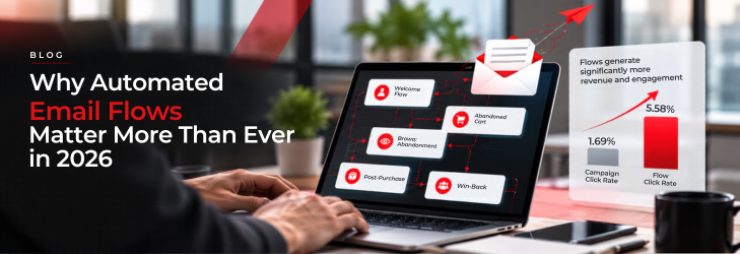
Klaviyo's 2026 ecommerce email marketing benchmarks illustrate the potential impact. Its dataset, covering more than 183,000 brands, reports that automated flows generated nearly 41% of email revenue from just 5.3% of sends. Flows also achieved a click rate of 5.58%, compared with 1.69% for campaigns.
These figures are specific to Klaviyo's benchmark dataset, and individual results will vary. However, they highlight an important opportunity: ecommerce brands can improve their email strategy by focusing not just on how often they send messages, but also on when and why they send them.
What Are Automated Email Flows?
Automated email flows are sequences of emails triggered by specific customer actions, profile information or lifecycle events. They allow businesses to communicate with subscribers and customers without manually scheduling every message.
Unlike traditional email campaigns, which are typically sent to a selected audience at a scheduled time, automated flows respond to individual customer behaviour.
For example:
A new subscriber joins: A welcome flow introduces the brand and its products.
A visitor browses a product: A browse abandonment flow provides a relevant follow-up.
A shopper abandons a cart: An abandoned cart flow reminds them of the products they selected.
A customer completes a purchase: A post-purchase flow provides useful information and encourages continued engagement.
A previous customer becomes inactive: A win-back flow attempts to rebuild the relationship.
These flows can include different messages, delays, conditions, and audience segments depending on the customer's actions.
The objective is simple: deliver useful communication when it matters most.
Which Ecommerce Email Flows Should Businesses Build?
Businesses don't need dozens of complicated automations to get started. A few well-designed flows can address important moments throughout the customer journey.
1. Welcome Flow
A welcome flow introduces your brand to new subscribers after they sign up.
It can explain what makes your business different, highlight popular products, share useful content and encourage a first purchase.
Rather than immediately sending repeated promotional offers, use the welcome sequence to establish trust and communicate your value.
Best suited for: Ecommerce brands looking to turn new subscribers into first-time customers.
2. Browse Abandonment Flow
A browse abandonment flow responds when someone views a product but leaves without adding it to their cart or completing a purchase, provided the business has the necessary tracking, consent, and eligibility.
The follow-up might highlight the product's benefits, answer common questions, or provide relevant recommendations.
Not every browse requires a reminder, so use appropriate eligibility rules and avoid sending unnecessary messages to casual visitors.
Best suited for: Brands with meaningful product browsing activity and enough customer data to make follow-ups relevant.
3. Abandoned Cart Flow
An abandoned cart flow targets shoppers who add products to their cart but leave without completing the purchase.
These customers have demonstrated a stronger purchase signal than someone who simply viewed a product.
A useful sequence might remind them about their selected items, clarify delivery or return policies, and address common purchase concerns. Discounts can be tested where appropriate, but they shouldn't automatically be the first response.
Best suited for: Ecommerce businesses experiencing significant cart abandonment and looking to recover potential sales.
4. Post-Purchase Flow
The customer journey doesn't end when someone places an order.
A post-purchase flow can confirm what happens next, share product instructions, answer common questions, and help customers get more value from their purchase.
Depending on the product and buying cycle, later messages might request feedback, recommend complementary products, or encourage a repeat purchase.
Best suited for: Brands looking to improve the customer experience, encourage repeat purchases, and build long-term relationships.
5. Win-Back Flow
A win-back flow attempts to re-engage customers who haven't purchased or interacted with a brand for a defined period.
The timing should reflect normal customer behaviour. A business selling everyday essentials may expect repeat purchases much sooner than a brand selling furniture or expensive electronics.
Messages can feature new products, useful recommendations, or a relevant incentive. Suppressing unresponsive contacts when appropriate also helps prevent unnecessary email fatigue.
Best suited for: Businesses with an established customer base and enough purchase history to identify meaningful inactivity.
Why Are Automated Email Flows Important?
Automated email flows help businesses make their communication more timely, relevant, and responsive to customer needs.
Their value comes from more than automation alone. It comes from connecting customer behaviour with an appropriate next action.
They respond to customer intent
Consider two subscribers.
One has just joined your mailing list and knows very little about your brand. The other has added a product to their cart but hasn't completed the purchase.
Sending both subscribers the same promotional email ignores the difference in their behaviour.
The new subscriber may need an introduction to the brand, while the second shopper may need a reminder or clarification about delivery.
Automated flows allow businesses to respond to these different signals with more relevant messages.
They deliver messages at relevant moments
Traditional campaigns are generally planned around a marketing calendar. This works well for launches, promotions, and seasonal announcements, but the timing may not align with every subscriber's needs.
Automated flows can respond to events such as subscribing, browsing, purchasing or becoming inactive.
For example, a post-purchase email can be triggered after an order rather than waiting for the next scheduled campaign.
The result is a more responsive customer experience.
They reduce repetitive manual work
Once configured, automated flows can run continuously while marketers focus on strategy, creative development, segmentation, and performance analysis.
However, automation still requires maintenance. Trigger conditions, message timing, exclusions, and content should be reviewed regularly to ensure the experience remains relevant.
They support revenue and customer retention
Automated flows can create opportunities to recover abandoned carts, convert new subscribers, encourage repeat purchases, and re-engage previous customers.
Klaviyo's 2026 benchmarks suggest that flows can contribute disproportionately to email revenue relative to their share of sends. However, this is a benchmark finding, not a guaranteed outcome for every business.
Performance depends on factors such as customer intent, list quality, product demand, audience segmentation, message relevance, and deliverability.
Ultimately, the goal is not simply to automate more emails. It is to create useful interactions that help customers move forward.
Email Campaigns vs. Automated Flows: What's the Difference?
Email campaigns and automated flows serve different purposes. An effective ecommerce email strategy uses both rather than treating one as a replacement for the other.
For example, a brand might use a campaign to announce a new product collection to its subscribers. A separate automated flow could follow up with eligible customers who browse products from that collection but don't purchase.
The two approaches can work together.
Campaigns communicate what your brand wants customers to know. Automated flows respond to what customers do.
Neither is sufficient on its own. Campaigns help maintain brand visibility, while well-designed flows address individual moments throughout the customer journey.
From Email Blasts to Lifecycle Marketing
Email automation becomes more valuable when it forms part of a broader lifecycle marketing strategy.
Instead of viewing each email as an isolated message, businesses can plan communication around the stages customers move through: discovery, consideration, purchase, retention, and re-engagement.
Each stage presents different opportunities.
Discovery: Welcome new subscribers and introduce the brand.
Consideration: Share relevant product information and address common questions.
Purchase: Help eligible shoppers overcome barriers to completing an order.
Retention: Improve the post-purchase experience and encourage repeat engagement.
Re-engagement: Reach out to eligible inactive customers with relevant content or offers.
This approach also makes it easier to identify gaps in the customer journey.
For example, a brand might have an effective welcome series but no post-purchase communication. Another might send regular promotional campaigns but fail to follow up with customers who abandon their carts.
Mapping the lifecycle helps businesses identify these missed opportunities and prioritize the flows most relevant to their goals.
It also creates a clearer measurement framework. Rather than evaluating email marketing solely through total revenue or campaign performance, businesses can assess individual flows according to their intended purpose.
Can Too Much Email Automation Hurt Performance?
Yes. Email automation can become counterproductive when messages are irrelevant, repetitive or poorly timed.
Automating a message doesn't automatically make it useful.
Common mistakes include:
Overlapping flows: Customers receive several automated emails triggered by different actions within a short period.
Poor segmentation: Subscribers receive recommendations or offers that don't reflect their interests.
Incorrect triggers: Customers continue receiving abandoned cart emails after completing their purchase.
Excessive discounting: Repeated incentives encourage customers to wait for offers instead of purchasing at full price.
Neglected deliverability: Poor list hygiene, excessive sending, or irrelevant content can increase complaints and harm inbox placement.
To avoid these problems, establish clear entry and exit conditions for each flow, apply appropriate suppression rules, and review the customer experience across all automated sequences.
Performance measurement matters too.
Useful metrics include:
Click rate and click-through rate, using consistent definitions.
Conversion rate and placed-order rate.
Revenue per recipient.
Unsubscribe and spam complaint rates.
Bounce rate and deliverability indicators.
Flow-level performance and customer journey drop-offs.
Open rates can provide some context, but privacy features and automated email activity can make them less reliable as a standalone measure of engagement.
Where possible, test different subject lines, message content, timing, and incentives. Use holdout groups or other appropriate measurement methods when you need to understand whether a flow actually caused additional purchases rather than merely receiving credit for purchases that would have happened anyway.
The goal is not maximum automation. It is useful automation that improves the customer experience and contributes to measurable business outcomes.
Frequently Asked Questions
What is email marketing automation?
Email marketing automation uses predefined rules and customer data to send relevant emails in response to actions, profile information, or lifecycle events. Common examples include welcome emails, abandoned cart reminders, post-purchase messages and win-back sequences.
Why are automated email flows important for ecommerce businesses?
Automated flows help ecommerce businesses respond to customer behaviour, communicate at relevant moments, reduce repetitive manual work, and support sales and retention. Their results depend on implementation, audience quality, message relevance, and measurement.
Are automated email flows better than traditional campaigns?
They serve different purposes. Campaigns are useful for promotions, product launches, and broad announcements, while automated flows respond to customer actions and lifecycle events. The most effective strategy usually combines both.
Is email automation useful for startups and small businesses?
Yes. Startups can begin with a small number of essential flows, such as welcome, abandoned cart, and post-purchase emails. Starting with a manageable set of automations makes it easier to maintain quality, measure performance, and expand when the business is ready.
How can businesses measure the success of email automation?
Track metrics that reflect each flow's objective, including click rate, conversion rate, revenue per recipient, unsubscribes, and spam complaints. Where possible, use controlled tests to determine whether automation generates incremental results.
Make Every Email More Relevant
Effective email marketing isn't about sending as many messages as possible. It's about understanding what customers need and responding with communication that fits the moment.
Automated flows help businesses move beyond one-size-fits-all messaging by connecting customer behaviour with relevant follow-ups throughout the buying journey.
Campaigns still have an important role in building awareness and communicating offers. Automation complements them by supporting subscribers and customers between those broader marketing moments.
Start with the customer interactions that matter most, build a few well-designed flows, and measure their actual impact. Then improve the system as you learn more about your audience.
Because better email marketing isn't just about reaching more inboxes. It's about making every relevant interaction count.